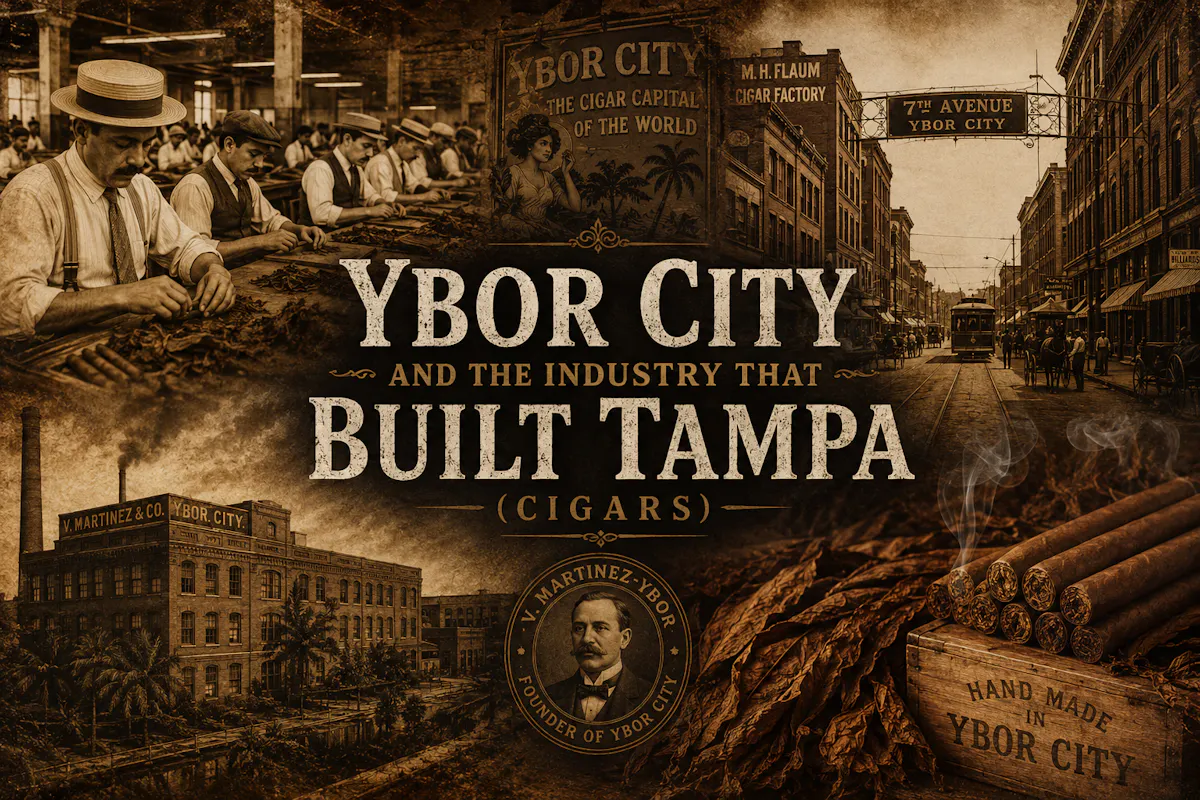
Ybor City and the Industry That Built Tampa (Cigars)
Every good pirate knows: the best stories are the ones that are true.
Before Tampa was a city, it was a fishing village with muddy streets, a struggling port, and a population you could fit inside a single cigar factory. Before Ybor City was a nightlife district, it was swampland — pine scrub and salt marsh on the northeast edge of nowhere.
The man who changed that wasn't a politician. He wasn't a general or a real estate developer. He was a cigar maker.
A Man Who Had Already Outrun One Empire
Vicente Martinez Ybor was born in Valencia, Spain in 1818 and had already lived several lifetimes before he ever set eyes on Tampa Bay. He'd built his first cigar factory in Havana under the name El Príncipe de Gales — Prince of Wales — and made a name for himself in an industry that was, at the time, the luxury good of choice for anyone with money and taste.
But Ybor had a problem. He was funding the Cuban rebels fighting for independence from Spain — the same Spain that had issued a warrant for his arrest. He escaped the island on a ship with his family, eventually making landfall in Key West, where he rebuilt his operation from scratch.
Key West worked for a while. But labor was restless, transportation was difficult, and Ybor had bigger ambitions. He needed room to build something that had never been built before: not just a factory, but a city.
In 1885, a Spanish civil engineer named Gavino Gutierrez traveled through Florida scouting locations for a new industrial settlement. He landed in a small Tampa town going exactly nowhere and saw exactly what Ybor needed: a port with potential, a railroad already threading through town, and enough open scrubland to build a world on.
Ybor almost didn't bite. He visited, walked the swampy acreage, and boarded a train for Jacksonville to look elsewhere. The Tampa Board of Trade — five local businessmen who understood exactly what they stood to lose — chased him down at the station and convinced him to turn back.
That moment, a man talking another man off a train platform, is the hinge on which Tampa's entire history turns.
Building a City from Tobacco Up
Ybor purchased 40 acres of scrubland just northeast of Tampa in 1885 and immediately set about building everything at once. Factories. Houses. Streets. A brewery (the first in the state of Florida). A streetcar line. Grocery stores. An insurance company. Gas stations. If his workers were going to come here and stay here, they needed a reason to.
He called the small worker-owned homes casitas — little houses — and sold them to employees at cost. This wasn't charity. It was strategy. Stable workers don't strike. Workers with mortgages don't leave. Ybor understood something most factory owners of his era refused to accept: a workforce with roots is a workforce with loyalty.
On April 13, 1886, the Sanchez & Haya company rolled the first cigar on 7th Avenue. By summer of that year, Ybor's own massive three-story brick factory was open and producing El Príncipe de Gales cigars — the same brand he'd started in Havana, rebuilt on American soil.
The method he used was called Havana Clear: Cuban tobacco, Cuban rollers, American address. He avoided import tariffs on finished cigars while delivering Cuban quality to American customers. It was, in the most flattering sense of the word, a hustle.
Other manufacturers followed. Then more after that. By 1899, there were nearly two dozen cigar factories operating in Ybor City. By 1910, there were over two hundred, producing more than a million cigars a day.
Tampa's population in 1880: roughly 720 people.
Tampa's population in 1900: over 15,000.
Tampa's population by 1929: more than 100,000.
The cigar built this city. That's not metaphor. That's the ledger.
The People Who Actually Rolled Them
The factories drew immigrants the way light draws moths — Cuban cigar makers first, then Spanish workers, then Sicilian Italians, then Eastern Europeans, some Chinese immigrants, small numbers of freedmen and African Americans. Each community staked its claim on a different stretch of the neighborhood and built the institutions that held it together.
The mutual aid societies are one of Ybor City's most underappreciated innovations. Each ethnic group formed its own club — El Círculo Cubano for white Cubans, La Unión Martí-Maceo for Afro-Cubans, L'Unione Italiana for Sicilians, the Centro Asturiano and Centro Español for Spanish workers. These weren't social clubs in the casual sense. They offered cooperative medical care, legal assistance, and community infrastructure at a time when none of those things were guaranteed to immigrants by anyone.
In a city built on hand labor, these societies were the knot that kept the rope from unraveling.
The Lectores: The Part They Never Put in the Tourism Brochures
Here is the part of the story that should get more airtime.
Inside every major cigar factory in Ybor City, there was a raised platform — la tribuna — and on that platform sat a man called el lector. His job was to read aloud to the workers while they rolled.
Not news headlines. Not company announcements. Everything. Newspapers, yes — but also Don Quixote. Emile Zola. The collected works of José Martí. Political essays on labor rights and socialist theory. Entire novels read aloud, chapter by chapter, over days and weeks, while hundreds of hands moved in practiced rhythm across tobacco leaves on long wooden benches.
The lectors were chosen by committee — by the workers themselves. At the end of each week, the rollers pooled up to twenty-five cents each to pay their reader's salary. They selected the material. They hired and they fired. The lector was their voice, not management's.
"Illiterate didn't mean ignorant," one lector later said. "Not if somebody was reading to them."
Factory owners grew nervous. The reading material grew increasingly political — workers began selecting more labor agitation literature, more socialist texts, more news about organizing movements. The lectors became lightning rods for a workforce that was becoming, by design, the most politically aware in Tampa. Possibly in Florida.
In 1931, after lectors helped publicize a major cigar workers' strike, the Cigar Manufacturers Association of Tampa formally banned them from the factory floors. The platforms were replaced with radios. Many former lectors went into broadcasting. Some became newspaper editors. Victoriano Manteiga, a celebrated lector, founded La Gaceta — still the only trilingual newspaper in the United States, still publishing today.
The tradition didn't die. It just changed its medium.
The Peak, the Fall, and the Thing That Never Left
The 1920s were Ybor City's apex. Over 400 million hand-rolled cigars produced every year. Hundreds of factories running, thousands of skilled workers earning good wages, restaurants and clubs and theaters running full.
Then the Great Depression arrived, and fine cigar demand collapsed. Mechanization displaced the hand rollers — machines didn't need lectores, didn't need casitas, didn't need mutual aid societies. In 1962, President Kennedy issued an executive order banning Cuban imports, including tobacco. The factories that had survived everything else lost their primary ingredient overnight.
Urban renewal and Interstate 4 did the rest. Buildings came down. People moved out. By the 1970s, Ybor City was largely abandoned.
The revival came slowly — artists first, then nightlife, then preservation efforts, then the National Historic Landmark District designation in 1990. The Columbia Restaurant, Florida's oldest, never closed. J.C. Newman Cigar Company never stopped rolling. The wild roosters — descendants of the chickens the original workers kept in their backyards — never left either.
Ybor City is still a cigar city. It just had to survive being everything else first.
Why This Story Lives Here
Pirate Cigar at Darkwater Alley isn't in Ybor City. We're in Pinellas Park, across the bay — but we exist in the same tradition, the same gravity.
Every hand-rolled cigar carries a lineage that runs back through Pinellas County, through Tampa Bay, through those brick-floored factory rooms where someone was always reading aloud. Every cigar lounge that takes its craft seriously is, in some small way, keeping faith with what was built on that swampy scrubland in 1885.
We tell stories here too. Some of them are tall tales. Some of them are meant for a purpose.
The best ones are true.
Come find us at Darkwater Alley — Pinellas Park's cigar lounge. Walk-ins always welcome. Private events available aboard The Pirate Vessel. Find out more here
Tags: Ybor City history, Tampa cigar history, Cigar City Tampa, cigar culture Florida, Tampa Bay history, hand-rolled cigars, cigar lounge Tampa Bay